SAP AI use case implementation lifecycle

Why many initiatives stall and how to get them right
Over the past several months, I have worked with SAP customers who are genuinely excited about bringing AI into their business. Teams are motivated, use cases are clear, and platforms like SAP BTP, Joule, and the rise of generative AI make experimentation easier than ever. On paper, everything seems ready. In practice, many organizations struggle to move beyond pilots, define meaningful outcomes, and achieve measurable results.
The challenge is rarely the technology itself. Many initiatives begin with energy and momentum. Teams quickly build models, experiment with large language models, and deploy dashboards or analytics. Along the way, foundational pieces are often overlooked. AI may not be aligned to core SAP business processes. Data may be incomplete or unmanaged. Governance is treated as an afterthought. User adoption is not prioritized. What begins as a promising initiative can quickly fragment into disconnected experiments that produce impressive results in demos but fail to deliver impact in day-to-day operations.
Organizations that achieve meaningful results treat SAP AI as an ongoing lifecycle rather than a one-time implementation, designing solutions with the expectation that they will evolve. Ownership is shared across both business and IT, with data quality, governance, and security established from the outset. Success depends just as much on people as it does on models, making user adoption critical. Even highly accurate AI outputs fall short if business users do not trust them, understand them, or know how to integrate them into daily workflows. Leading organizations address this by embedding AI into existing processes, building structured training programs, and creating usage playbooks so it becomes a natural part of how work gets done rather than an added step.
Clear metrics are also essential for sustained success. Organizations that track outcomes such as prediction accuracy, reduced manual effort, faster cycle times, and adoption rates are better positioned to iterate and improve over time. Feedback loops help ensure AI solutions evolve alongside the business, while shared ownership across functions keeps efforts aligned. SAP AI is not an isolated IT initiative but a business capability enabled by technology, bringing together functional leaders, SAP architects, AI specialists, and business users to define use cases, validate results, and ensure value is delivered. Without this collaborative ownership, even well-designed initiatives can lose direction.
A structured SAP AI lifecycle helps organizations move from experimentation to enterprise-scale adoption.
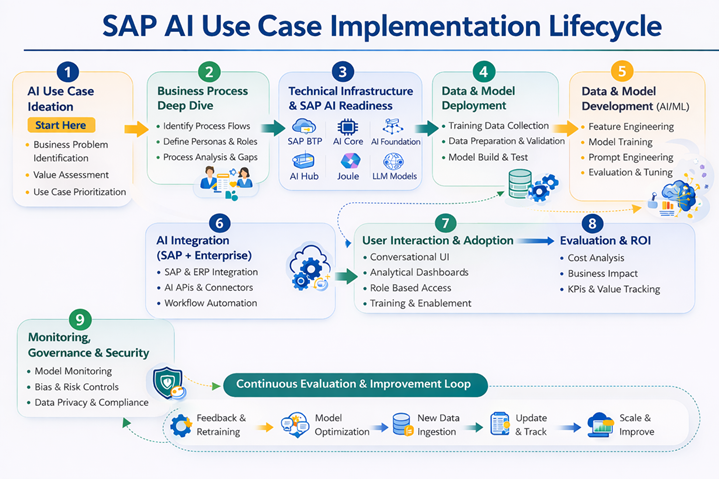
Step 1 – AI use case ideation involves identifying business challenges, quantifying their impact, aligning stakeholders, assessing potential value, and prioritizing initiatives. For example, frequent discrepancies between freight invoices and SAP financial postings create delays and manual effort. AI can help pinpoint variance drivers and improve accuracy while reducing time spent on reconciliation.
Step 2 – Business process deep dive, personas & roles requires mapping end-to-end workflows, defining roles and responsibilities, baselining current effort, and assessing opportunities where AI insights can enhance decision-making. Understanding who performs which tasks at each stage is critical to embedding AI effectively.
Step 3 – SAP AI readiness & technical foundation includes reviewing SAP BTP architecture, AI entitlements, and security frameworks, and determining which AI services such as embedded analytics, conversational AI, or predictive models are appropriate for the use case.
Step 4 – training data readiness & validation focuses on gathering historical enterprise data, cleansing and normalizing it, establishing governance and access controls, and preparing datasets for model training or grounding.
Step 5 – Model Strategy, Prompt Design, Development & Validation involves selecting the right AI approach, configuring or building models, grounding outputs in enterprise data, and ensuring reliability and explainability.
Step 6 – AI Integration, Orchestration & Experience Enablement includes integrating AI into SAP applications and workflows, orchestrating data and AI processes, and embedding insights in dashboards or Fiori apps.
Step 7 – AI Consumption, User Adoption & Change Enablement focuses on training business users to interpret outputs, interact with conversational AI or dashboards, and apply insights in their workflows while establishing feedback channels for continuous improvement.
Step 8 – AI Value Realization, KPI Tracking & ROI Management tracks business metrics, efficiency gains, financial impact, adoption, and alignment with objectives.
Step 9 – AI Operations, Governance & Continuous Lifecycle Management includes monitoring model performance, managing retraining, enforcing governance, and refining workflows based on feedback.
Consider freight variance analysis as an example
Manual reconciliation of freight invoices and SAP financial postings is slow and prone to error. AI can automatically identify variance drivers by analyzing shipment history, contracts, and invoices. The value comes from mapping the process, preparing high-quality data, embedding insights into workflows, and enabling teams to act quickly. What previously took days can now be done in minutes with improved accuracy and visibility. Even with the right technology, common pitfalls remain.
Starting with technology instead of real business problems often leads to solutions without clear direction. Poor data quality can introduce issues that don’t appear until later, while skipping process analysis can result in AI that doesn’t align with how work actually gets done. Neglecting adoption limits how widely solutions are used, and delaying governance only increases risk over time. Effective teams recognize these challenges early and address them intentionally from the start.
Frequently asked questions
- What type of AI interface should be used? Conversational AI like Joule is suitable for executives and quick insights. Analytical dashboards are better for operational teams. Embedded AI within SAP applications supports automation and process decisions.
- If SAP foundation models are used, do we still need training data? Yes. Contextual enterprise data is needed to ground outputs. Retrieval-based grounding, prompt design, and validation ensure accuracy and relevance.
- What kind of security is required? Role-based access, data protection, governance, and monitoring are essential, aligned with enterprise standards.
- How can AI use SAP data securely? Configure AI services within SAP BTP with secure connections to S/4HANA or Datasphere, controlling access through APIs and governance.
- What user training is required? Users need guidance on interpreting AI outputs, interacting with interfaces, and applying insights to daily work.
- How do we measure success and adoption? Metrics include productivity gains, reduced manual effort, accuracy, and active engagement.
- How long does implementation take? Initial deployments typically range from six to sixteen weeks depending on complexity and data readiness.
- What team structure is needed? Cross-functional teams including SAP architects, data engineers, AI specialists, domain experts, and business stakeholders are critical.
- Do all use cases require ML models? No. Some rely on generative AI, rules engines, or embedded analytics depending on the problem.
- How often should AI models be retrained? Retraining frequency depends on data changes, often monthly or quarterly to maintain accuracy and relevance.
SAP AI success is not determined by technology alone. It is determined by how well AI is connected to business processes, data, and people. When solutions are aligned to real processes, supported by high-quality data, and adopted by users, experimentation becomes enterprise value. Organizations see measurable outcomes, improved efficiency, and insights that drive better decision-making.
Continue reading

AI and Agile: It’s not about maturity, it’s about momentum
AI and Agile: more than a maturity question When organizations think about using AI to become…

Building an AI-ready enterprise: the foundations most companies miss
Artificial intelligence has moved decisively from discretionary innovation to mandatory enterprise capability, and 2026 marks the…

Q4 2025 compliance & remediation update
Introduction Welcome to our Turnberry compliance and remediation update for Q4 2025. Each quarter, our C&R…